
About
The Pronghorn Xing project is a collaborative initiative aimed at enhancing ecological connectivity across the Northern Sagebrush Steppe (NSS) in Alberta and Saskatchewan to both conserve pronghorn and other grassland species and deliver regional wildlife conservation and public safety.
There are four key messages we wish to convey:
Our Approach
Pronghorn are native to North America's grasslands and are known for their complex and adaptive migrations. However, human-made barriers such as fences and roads have disrupted these natural movements, limiting access to essential habitats and resources. Studies have shown that pronghorn encounter fences on-average 244 times a year, with a portion of these interactions leading to a change in direction, or worse, becoming trapped. In addition to fences, Pronghorn avoid high-traffic roads such as the Trans-Canada Highway (TCH) where they risk getting hit. Highway avoidance further impedes their ability to connect to habitats vital to their conservation.
- Fence impermeability prioritization
- High valued ecological connectivity areas
- Wildlife and motorist safety road mitigation system
- Pronghorn crossing site prioritization
These four scientific assessments resulted in six priority sites for road enhancement, as seen in the graphic below.
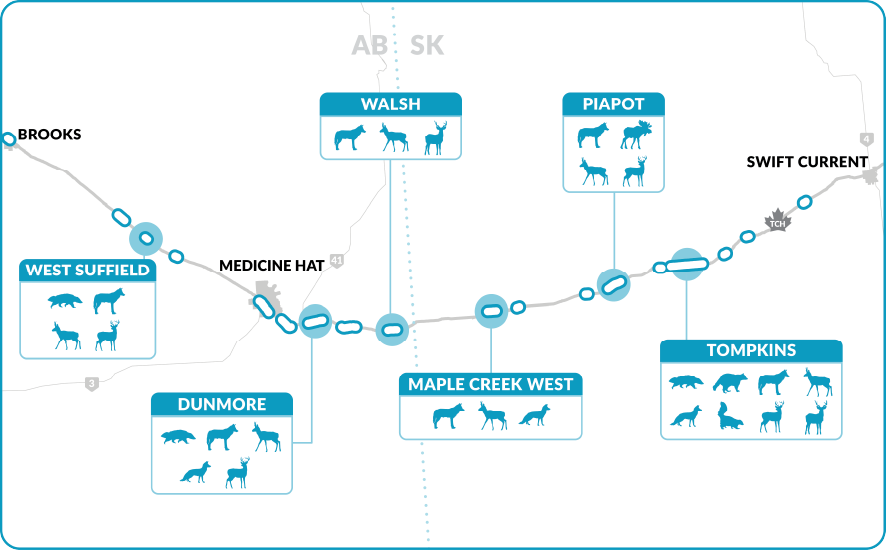
Six potential road enhancement sites along the Trans-Canada Highway (TCH), as part of a road mitigation system to conserve grassland species and deliver regional conservation and public safety.
In 2026, Pronghorn Xing completed a multi-year biodiversity monitoring program using remote cameras and acoustic recording units (ARUs) setup at the proposed six enhancement sites along the TCH, to document other grassland species that could benefit from a road mitigation system and enhanced connectivity, including species at risk.
Pronghorn Xing is following the outcomes of two new studies; Pronghorn Winter Survival and Migration (website coming shortly) and Alberta Mule Deer Collaring Project (www.albertacollaringproject.com).
For more detailed information and access to our comprehensive reports, please visit the Resources page.
Project History
The Pronghorn Xing project started in 2017 as a citizen science initiative focused on pronghorn conservation in the Northern Sagebrush Steppe. The program engaged the public in reporting sightings of pronghorn and other wildlife near roads—whether crossing, adjacent, or involved in collisions—using smartphone technology and an online mapping tool. This data, in combination with four other scientific assessments, has contributed to understanding how connectivity can be improved in the Canadian Northern Sagebrush Steppe for pronghorn and other grassland species. We have identified six potential pronghorn road enhancement sites along the Trans-Canada Highway where road mitigation (e.g., overpasses, underpasses, fencing) would benefit pronghorn migration and grassland connectivity.
As of October 2024, Pronghorn Xing is in the engagement and outreach phase of the project where we will connect with key audiences to promote implementation of a road mitigation system between Brooks, Alberta and Swift Current, Saskatchewan, to both conserve grassland species and deliver regional wildlife conservation and public safety.
Collaborative Efforts
The success of this project hinges on the collaboration. We are currently in the engagement phase of Pronghorn Xing, where we are working to communicate the importance of grassland connectivity and wildlife crossing infrastructure to our core audiences. If you are one of our core audiences, we would appreciate the opportunity to meet and present Pronghorn Xing to you and your staff/community. Our core audiences are:
- Federal government
- Provincial governments
- Local governments
- Indigenous Communities
- Industrial and commercial stakeholders
- Landowners
- Subject matter experts
- General public
If you are interested in a presentation to your agency or organization on Pronghorn Xing, or if you would like to learn more, or have a question please contact info@pronghornxing.org.